


Article: How to Choose Kitchen Pendant Lights: Size, Style and Spacing

How to Choose Kitchen Pendant Lights: Size, Style and Spacing
To choose kitchen pendant lights, start with the island: measure its length, pick the number of pendants (usually two for islands under about 7 feet, three for longer ones), size each pendant so the group fills roughly two-thirds of the island's length, then hang them 30 to 36 inches above the counter. Only after the math works should you choose the shade, glass and finish that suit your kitchen's style.
Kitchen pendants are one of the few lighting decisions that are both highly visible and highly practical. They sit at eye level in the busiest room of the house, they have to light a work surface, and they are hard to move once the electrician has set the boxes. This guide walks through the decisions in the order we make them with clients: size and count, spacing, height, shade type, light output and finish.
How many pendants should go over a kitchen island?
The number of pendants follows the island's length and the size of the fixture you love. As a rule:
- One pendant suits a short island or peninsula (under about 5 feet) or a single oversized linear fixture.
- Two pendants suit most islands from about 5 to 7 feet long, especially with larger shades (15 inches and up).
- Three pendants suit islands 7 feet and longer, or smaller shades (under about 12 inches) that would look sparse as a pair.
Odd numbers are not a rule. Two large pendants often look calmer and more tailored than three small ones.
What size kitchen pendant do I need?
A quick method: subtract about 12 inches from the island's length, divide the remainder by the number of pendants, and keep each pendant's width comfortably under that figure so there is breathing room between shades. Then sanity-check against these typical ranges:
| Island length | Common setup | Pendant width | Approx. center-to-center spacing |
|---|---|---|---|
| 4 to 5 ft (48" to 60") | 1 large or 2 small | 18" to 24" (single) or 10" to 13" (pair) | 24" to 30" |
| 6 ft (72") | 2 pendants | 14" to 18" | 30" to 36" |
| 7 ft (84") | 2 large or 3 medium | 16" to 21" (pair) or 10" to 14" (trio) | 28" to 36" |
| 8 to 9 ft (96" to 108") | 3 pendants | 12" to 16" | 30" to 36" |
| 10 ft+ (120"+) | 3 or 4 pendants, or a linear fixture | 12" to 18" | 30" to 40" |
Two more clearances matter: keep the outer edge of the end pendants at least 6 inches in from the ends of the island, and leave at least 24 to 30 inches between shades so they read as separate objects rather than a crowded row.
Shop the look
Tap the dots to shop this room

Shop the look
How high should kitchen pendants hang?
The standard is 30 to 36 inches from the countertop to the bottom of the pendant. On a typical 36 inch counter, that puts the bottom of the fixture about 66 to 72 inches from the floor. Hang toward 30 inches for clear or open shades and shorter households; toward 36 inches for solid domes, tall family members, or when you want an unobstructed view across the island to a range or living area. With ceilings above 9 feet, keep the 30 to 36 inch rule and let a longer stem or chain take up the difference. Our full guide on how high to hang pendant lights over a kitchen island covers tall ceilings, sloped ceilings and bar-height counters.
Which shade type is best for kitchen task lighting?
Shade material decides how much light reaches the counter and how much glare reaches your eyes.
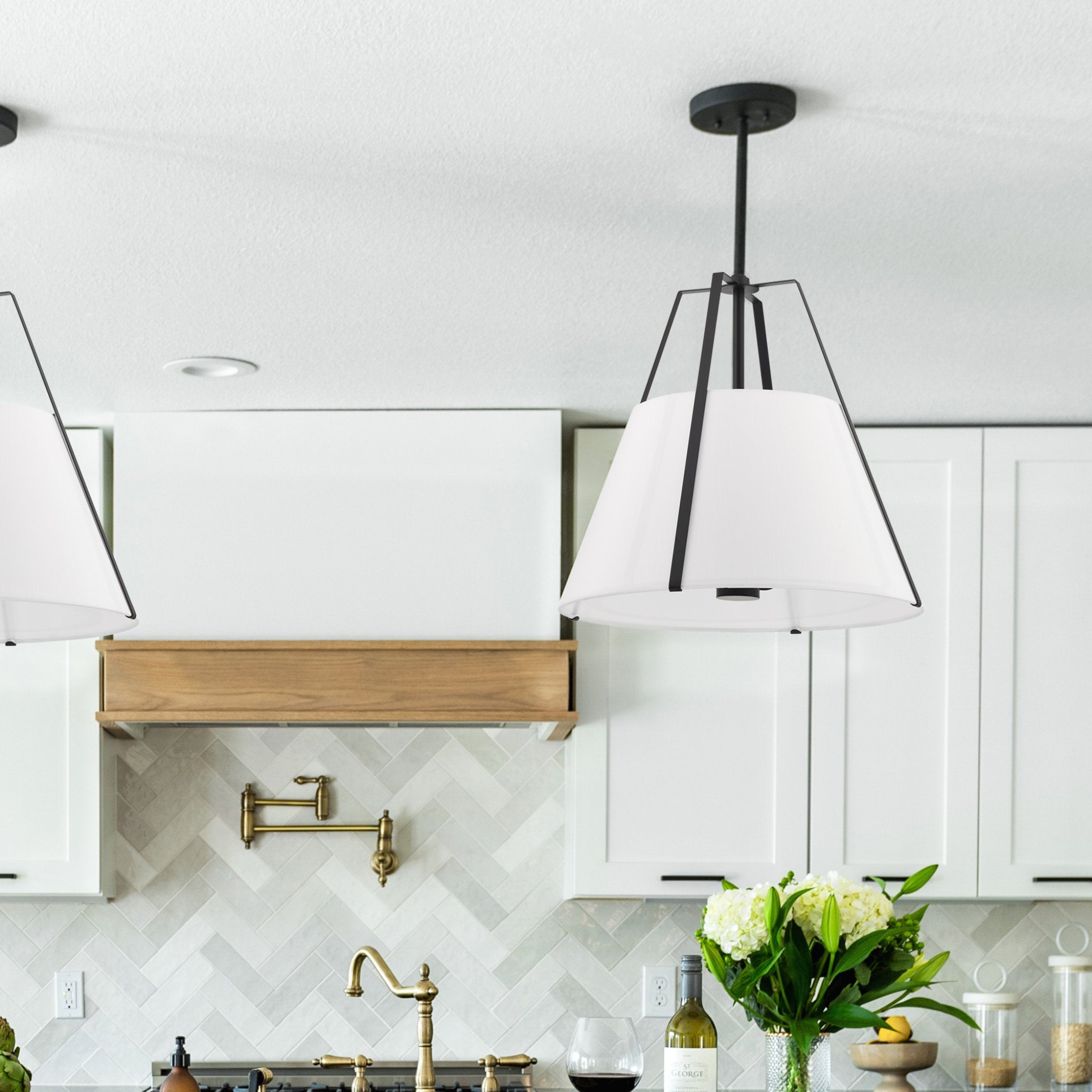
- Solid metal domes push light straight down onto the work surface. They are the most practical for prep and hide the bulb from seated guests. Look for a white or light-colored interior, which reflects more light.
- Opal or white glass gives a soft, even glow in all directions: good for general light, slightly less focused for chopping.
- Clear or seeded glass shows off the bulb and adds sparkle. Pair it with a decorative, dimmable bulb and make sure recessed or under-cabinet lights handle serious task work.
- Prismatic glass spreads light broadly while controlling glare, a traditional industrial choice that works well over long islands.
- Fabric or woven shades are best over a breakfast table or peninsula seating rather than the main prep zone, as they are harder to keep clean near a cooktop.
How bright should kitchen pendants be, and what color temperature?
Kitchens need more light than living spaces. Island pendants are usually one layer among recessed lights and under-cabinet strips, so they do not have to carry the room alone. For the pendants themselves, we suggest:
- Color temperature: 2700K to 3000K for kitchens that open to living areas; 3000K to 3500K if you want crisper light for prep. Keep every source in the room within about 500K of each other so they match.
- Color rendering: CRI 90 or higher, which makes food, stone and wood look true.
- Dimming: put pendants on their own dimmer, separate from recessed lights, so the island can shift from workstation to dinner spot.
For a room-by-room Kelvin guide, see warm white vs cool white lighting.
How do you choose a pendant style and finish?
Once the dimensions are settled, style decisions are easier:
- Take a cue from the hardware and faucet. Pendants do not have to match exactly, but they should share a family (warm metals with warm metals, or a deliberate contrast such as bronze pendants with nickel hardware).
- Consider the view. In an open plan, pendants are seen from the living room. Airy glass keeps sightlines open; solid domes create a stronger visual line.
- Match the architecture. Traditional and farmhouse kitchens suit acorns, lanterns and prismatic glass; modern kitchens suit clean domes, globes and cylinders; transitional kitchens can go either way.
- Think about cleaning. Kitchen pendants collect grease near the range. Open-bottom glass and metal are easiest to wipe down.
Want to see what is new in kitchen design? Our roundup of kitchen lighting trends designers love shows current finishes and shapes.
Get the look: five kitchen pendants that work
These in-stock pendants cover the main shade types, each with a clear size so you can apply the table above.
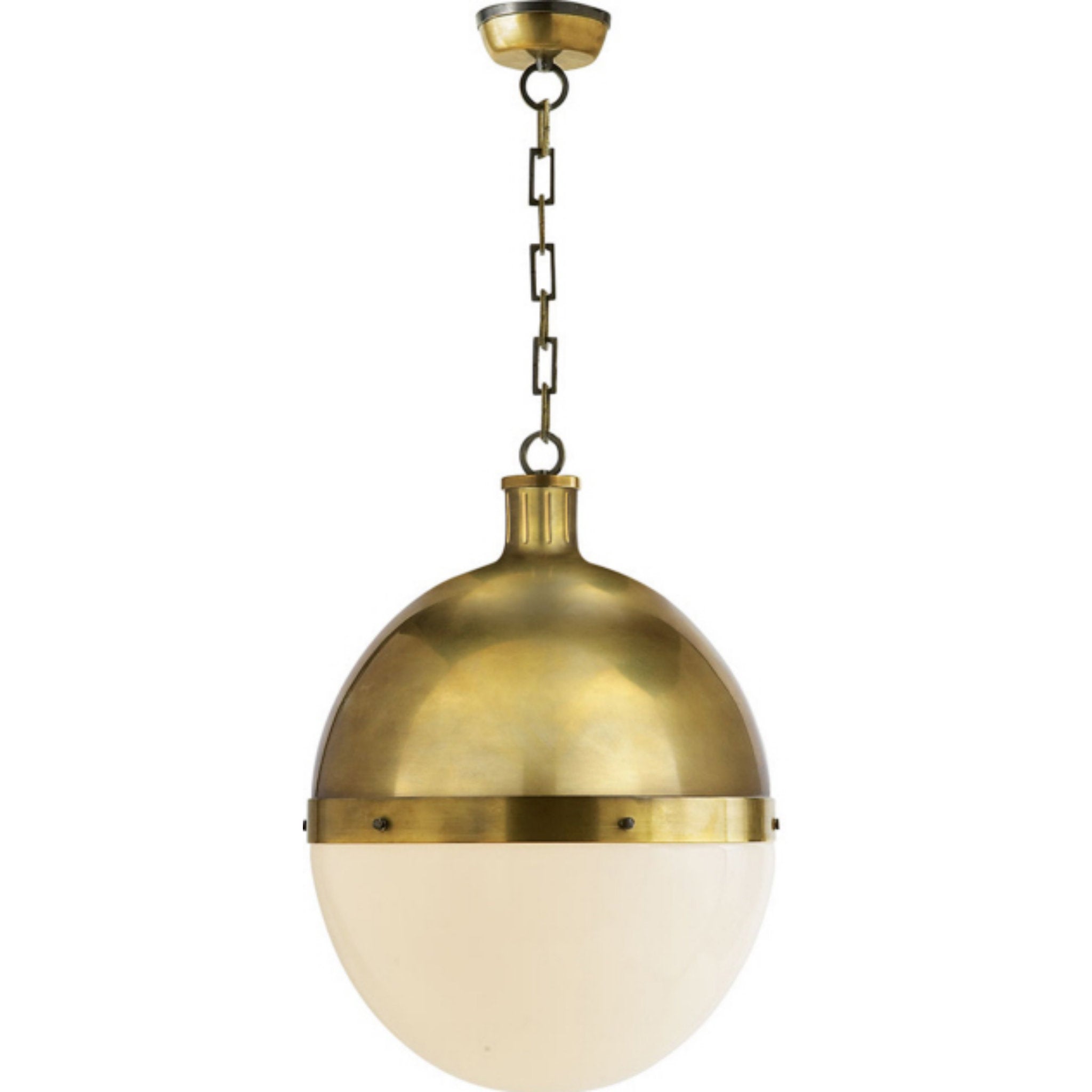
Thomas O'Brien Hicks Extra Large Pendant in Hand-Rubbed Antique Brass pairs a brass cap with a white glass shade. At W16.5" x H21.75", two of them suit a 7 to 8 foot island, and the white glass gives even, glare-free light.
Thomas O'Brien Katie Acorn Pendant in Bronze with Clear Glass is compact at W10.5" x H13.75", ideal as a trio over a long island in a traditional or farmhouse kitchen, where the clear glass keeps sightlines open.
Thomas O'Brien Eugene Large Pendant in Hand-Rubbed Antique Brass is a solid metal dome at W21". Use it singly over a short island or as a pair over a generous one when you want strong downlight for prep.
Chapman & Myers Boston Pendant in Hand-Rubbed Antique Brass with Mini Slant Shade is a slim W7.25" option for peninsulas, a sink window, or a row of three or four over a narrow island.
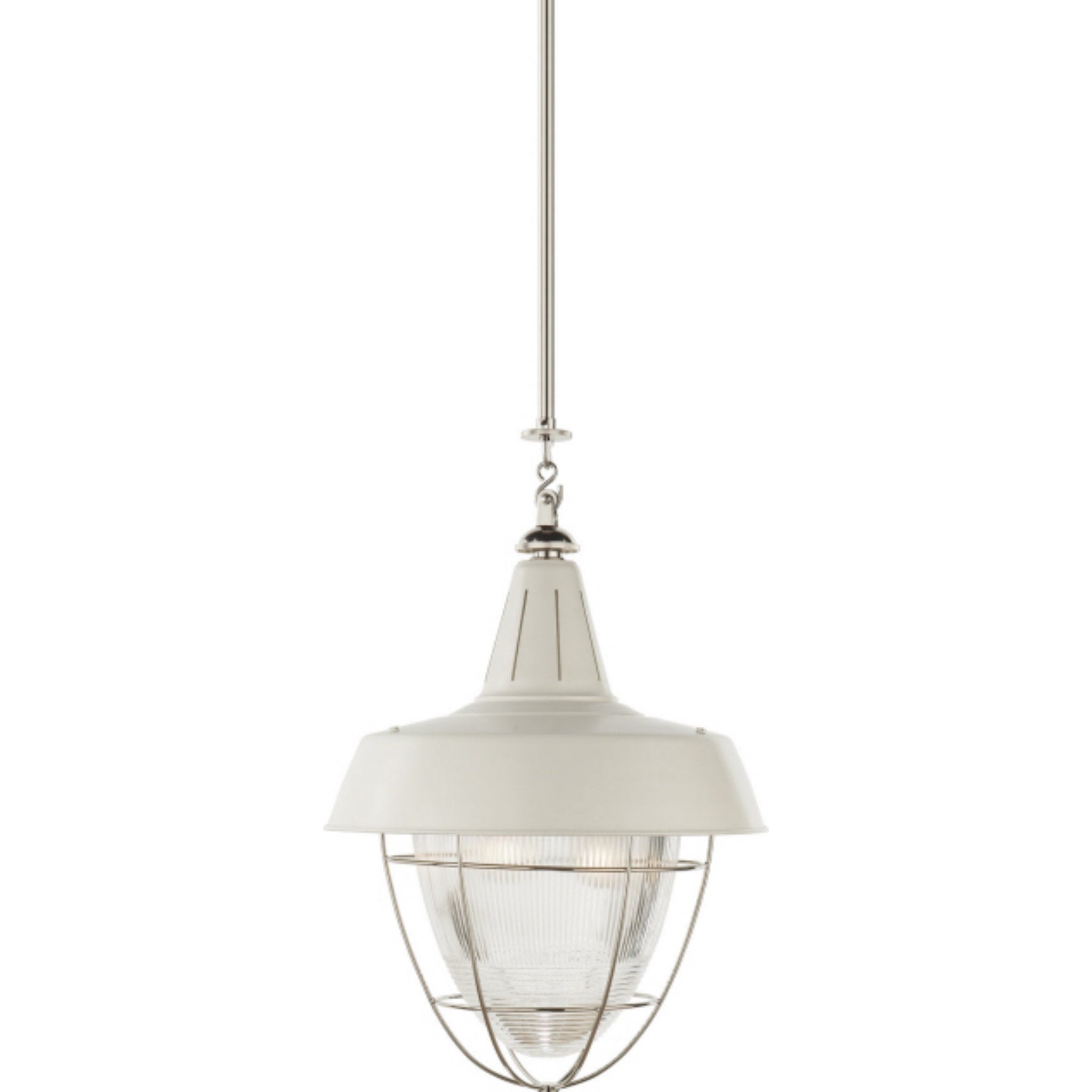
Thomas O'Brien Henry Industrial Hanging Light in Polished Nickel combines a white shade with prismatic glass at W18", a good choice over long islands where you want broad, controlled light with a classic industrial look.
Shop more ceiling lights or the Thomas O'Brien collection, and see our ready-to-ship dining lighting if the island doubles as your dinner table. Designers working on kitchen projects can ask about our Design Trade Program.
Shop this post


Frequently asked questions
How many pendant lights should go over a kitchen island?
Most islands 5 to 7 feet long look best with two pendants, and islands 7 feet or longer usually take three. Very short islands can take one large pendant. The size of the fixture matters too: two large shades often look calmer than three small ones, so choose the count and size together.
How far apart should kitchen island pendants be?
Space pendants about 30 to 36 inches apart, center to center, with at least 24 inches of open space between shades. Keep the outer edges of the end pendants at least 6 inches in from each end of the island so the light lands on the counter and the arrangement looks balanced.
What size pendant light for a 6 foot island?
A 6 foot (72 inch) island typically takes two pendants about 14 to 18 inches wide, spaced 30 to 36 inches apart. If you prefer smaller shades under 12 inches, use three. Measure so the pendants leave at least 6 inches of counter beyond each outer edge.
Should kitchen pendants match the hardware?
They do not have to match exactly, but they should relate. Pendants in the same metal family as the faucet and hardware look cohesive, while a deliberate contrast, such as bronze pendants with nickel hardware, also works if it is repeated elsewhere in the room. Avoid three or more unrelated finishes.
Are glass or metal pendants better for a kitchen island?
Metal domes direct light down onto the counter and hide the bulb, making them better for task lighting. Clear glass keeps sightlines open and adds sparkle but can glare, so pair it with dimmable decorative bulbs and good recessed or under-cabinet lighting. White or opal glass is a balanced middle ground.
Designing a whole room?
Our lighting specialists help size and pair fixtures every day, and interior designers and architects can join the Design Trade Program. Browse more ideas in Inspiration.



,%20size%20each%20pendant%20so%20th...)