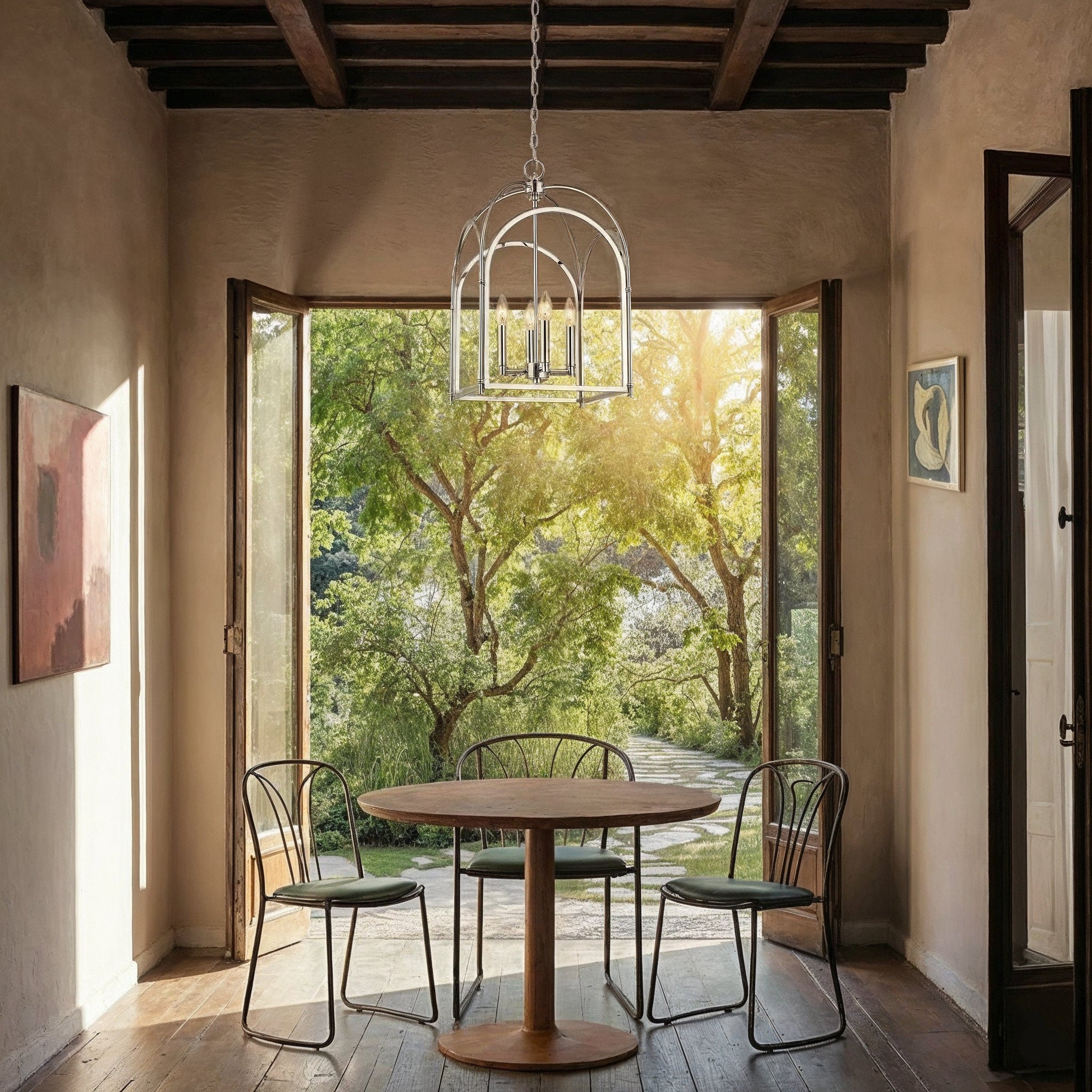


Article: Foyer Chandelier Ideas: Size, Height and Style

Foyer Chandelier Ideas: Size, Height and Style
A foyer chandelier should be sized so its diameter in inches roughly equals the entry's length plus width in feet, with about 2.5 to 3 inches of fixture height for every foot of ceiling height. Keep at least 7 feet of clearance below it; in a two-story foyer, hang it so the bottom sits near the second-floor line and it centers in the front window.
The entry is the first room anyone sees and the last one they walk through on the way out. It is also one of the trickiest to light: ceilings can run from a standard 8 feet to a soaring 20, doors swing through the space, and the fixture is visible from the street, the stairs, and the landing above. Below are the sizing formulas, hanging heights, and style choices designers rely on, plus the fixtures we used to light the entry in this story.
What size chandelier do you need for a foyer?
Start with the classic formula: add the length and width of the foyer in feet, and use that number in inches as the chandelier's diameter. A 12-by-12-foot entry calls for a fixture about 24 inches across. A 16-by-18-foot entry calls for roughly 34 inches.
Then check height. For a balanced look, allow about 2.5 to 3 inches of fixture height per foot of ceiling height. A 10-foot ceiling suits a fixture 25 to 30 inches tall; an 18-foot two-story ceiling can carry 45 to 54 inches.
| Foyer size (feet) | Chandelier diameter | Ceiling height | Fixture height |
|---|---|---|---|
| 8 x 8 | about 16" | 8 ft | flush or semi-flush, 12–20" |
| 10 x 10 | about 20" | 9 ft | 22–27" |
| 12 x 12 | about 24" | 10 ft | 25–30" |
| 14 x 14 | about 28" | 12 ft | 30–36" |
| 16 x 18 | about 34" | 16 ft | 40–48" |
| 20 x 20 | about 40" | 18–20 ft | 45–60" |
Treat these as starting points, not laws. Open railings, tall windows, and a sweeping stair make a space read larger, and an entry that opens straight into a living room can take a bigger fixture than its footprint suggests. For the full formula across every room, see our chandelier size guide.
How high should you hang a foyer chandelier?
The non-negotiable rule is clearance: leave at least 7 feet from the floor to the bottom of the fixture anywhere people walk. Beyond that, the right height depends on the ceiling.
- 8-foot ceilings: choose a flush or semi-flush mount. A hanging chandelier will almost always drop below 7 feet.
- 9- to 10-foot ceilings: a compact chandelier or lantern works, as long as the bottom still clears 7 feet. On a 10-foot ceiling, that means a fixture and chain of no more than 36 inches combined.
- Two-story foyers: hang the fixture so the bottom sits roughly level with the second floor, never below the 7-foot line. If there is a window above the front door, center the chandelier in it so the light reads from the street.
Watch the door. A tall front door, especially one with a transom, can swing close to a low-hanging fixture. Check the arc of the door and any storm door before you finalize the chain length.
Shop the look
Tap the dots to shop this room

Shop the look
How do you light a two-story foyer?
A two-story entry needs more than one big fixture. The chandelier provides the moment, but its light is far from the floor, and it cannot reach the walls or the console by itself. Plan three layers:
- The chandelier as the focal point, scaled to the full height of the space.
- Wall sconces at human scale, typically a pair flanking a console and mirror, mounted about 60 to 66 inches from the floor to the center of the fixture.
- A lamp on the console, which brings warm light down to the level where people set down keys and mail, and gives the entry a lived-in glow in the evening.
Put the chandelier and sconces on separate dimmers. At night, the sconces and lamp can carry the room on their own while the chandelier glows at a low level, which is kinder to anyone coming downstairs. For more on how layers work together, read our guide to layering lighting like a designer.
What style of chandelier works in an entryway?
The foyer sets expectations for the rest of the house, so the fixture should preview the home's style without shouting over it.
- Traditional and transitional homes: candle-style chandeliers with seeded glass or brass arms, and classic hanging lanterns. Both feel architectural and look right from the street.
- Modern homes: globe lanterns, sculptural brass, or a single large pendant with a strong silhouette. Simple forms read best when the space is tall and open.
- Coastal and farmhouse entries: iron and zinc lanterns, rope, or rattan, in finishes that echo door hardware and stair railings.
Think about the view from the landing. In a two-story foyer, people see the top of the fixture from upstairs, so a lantern or chandelier that looks finished from above, with no exposed wiring clutter or unsightly canopy, is worth prioritizing. Browse our full range of chandeliers and ceiling lights with that angle in mind.
Should foyer lighting match the rest of the house?
Coordinate, don't clone. Repeat one finish from nearby rooms, such as antique brass that also appears in the dining room chandelier, so the eye travels smoothly from the entry into the house. The form can differ. It also helps to keep color temperature consistent: 2700K to 3000K bulbs with a CRI of 90 or higher make wood floors, paint, and art look true and welcoming. If the front door has glass, your foyer light becomes part of the facade at night, so choose a Kelvin that matches your exterior lanterns. Our guide to curb appeal outdoor lighting covers the outside half of that picture.
Common foyer lighting mistakes
- Undersizing the fixture. A chandelier that looks right in the showroom can disappear in a 20-foot entry. When in doubt between two sizes in a tall space, go larger.
- Hanging it too high. A fixture pushed tight to a two-story ceiling leaves the lower half of the room dark and looks like an afterthought.
- Relying on one light. Without sconces or a lamp, the entry feels cavernous at night.
- Ignoring maintenance. In a two-story entry, plan how you will change bulbs and clean glass. Long-life LED bulbs and a fixture that can be reached with a tall ladder save headaches.
Featured in this foyer
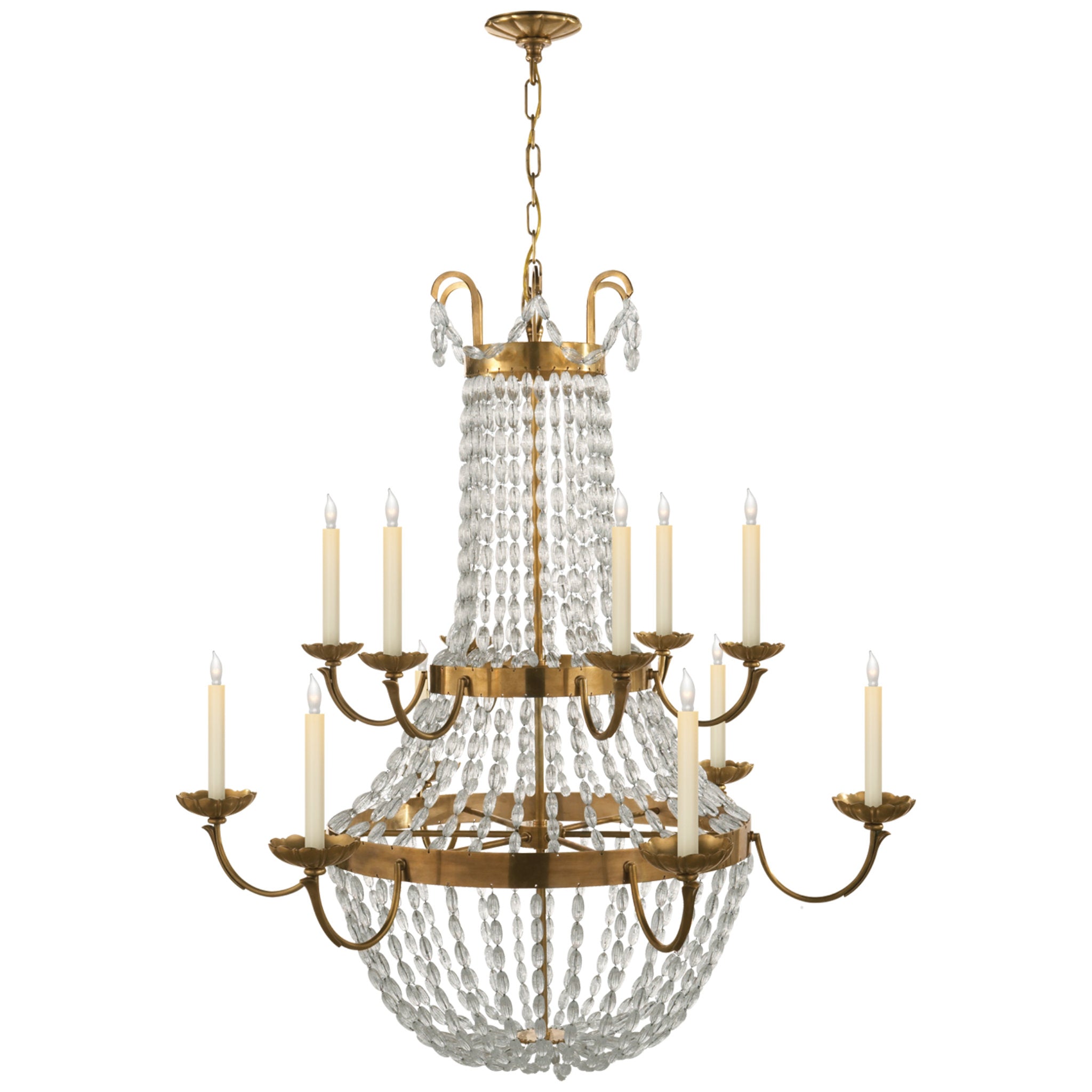
Chapman & Myers Paris Flea Market Grande Chandelier in Antique-Burnished Brass with Seeded Glass — W39.5" x H41". At nearly 40 inches across and 41 inches tall, this is a true two-story fixture, suited to an entry around 20 by 20 feet with a ceiling of 16 feet or more. The seeded glass scatters light beautifully when viewed from the landing.
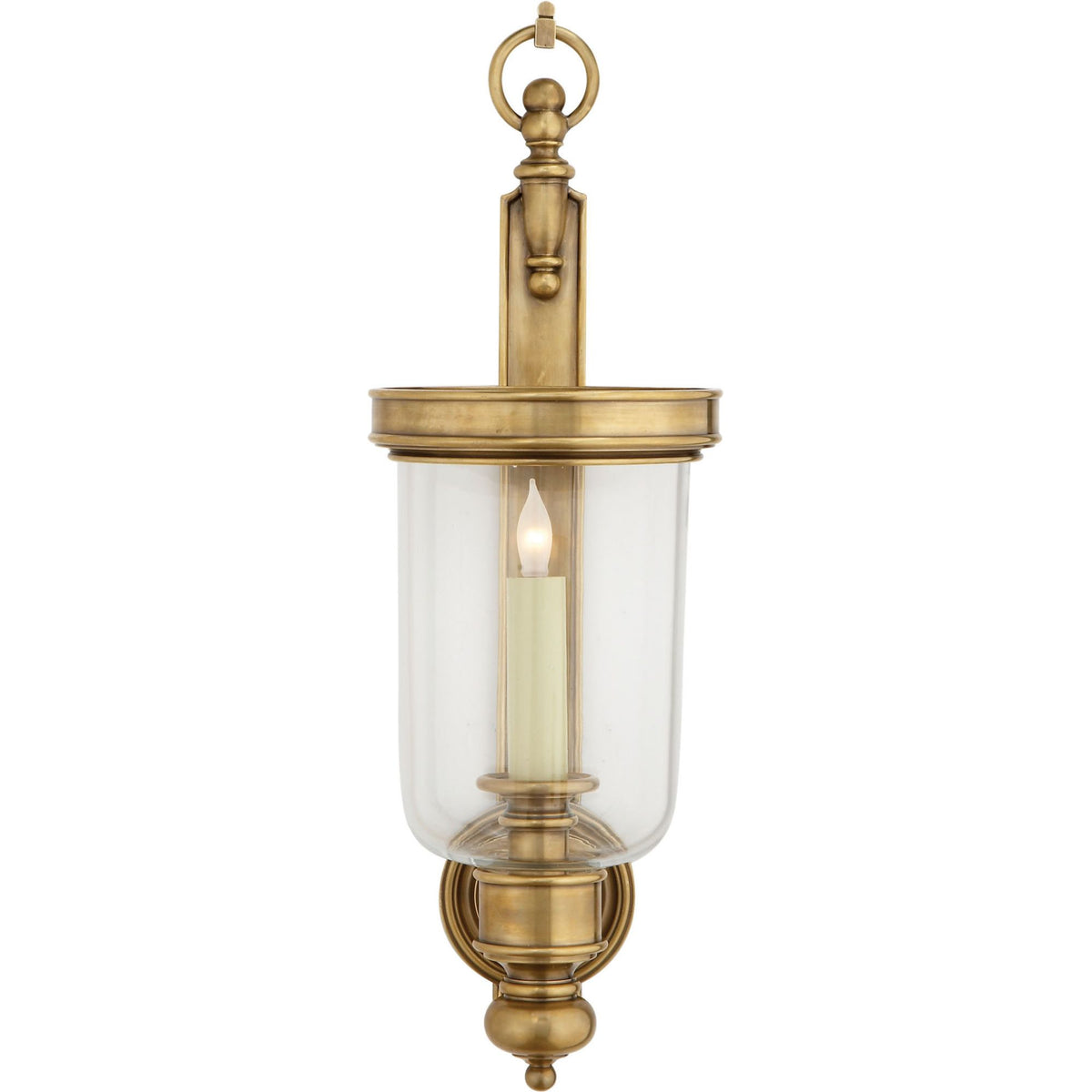
Chapman & Myers Georgian Small Hurricane Wall Sconce in Antique-Burnished Brass — W7.5" x H22" x E8.75". A pair flanking a console mirror brings the chandelier's brass down to eye level. The hurricane glass gives a candlelit, traditional feel that pairs naturally with a grand stair.
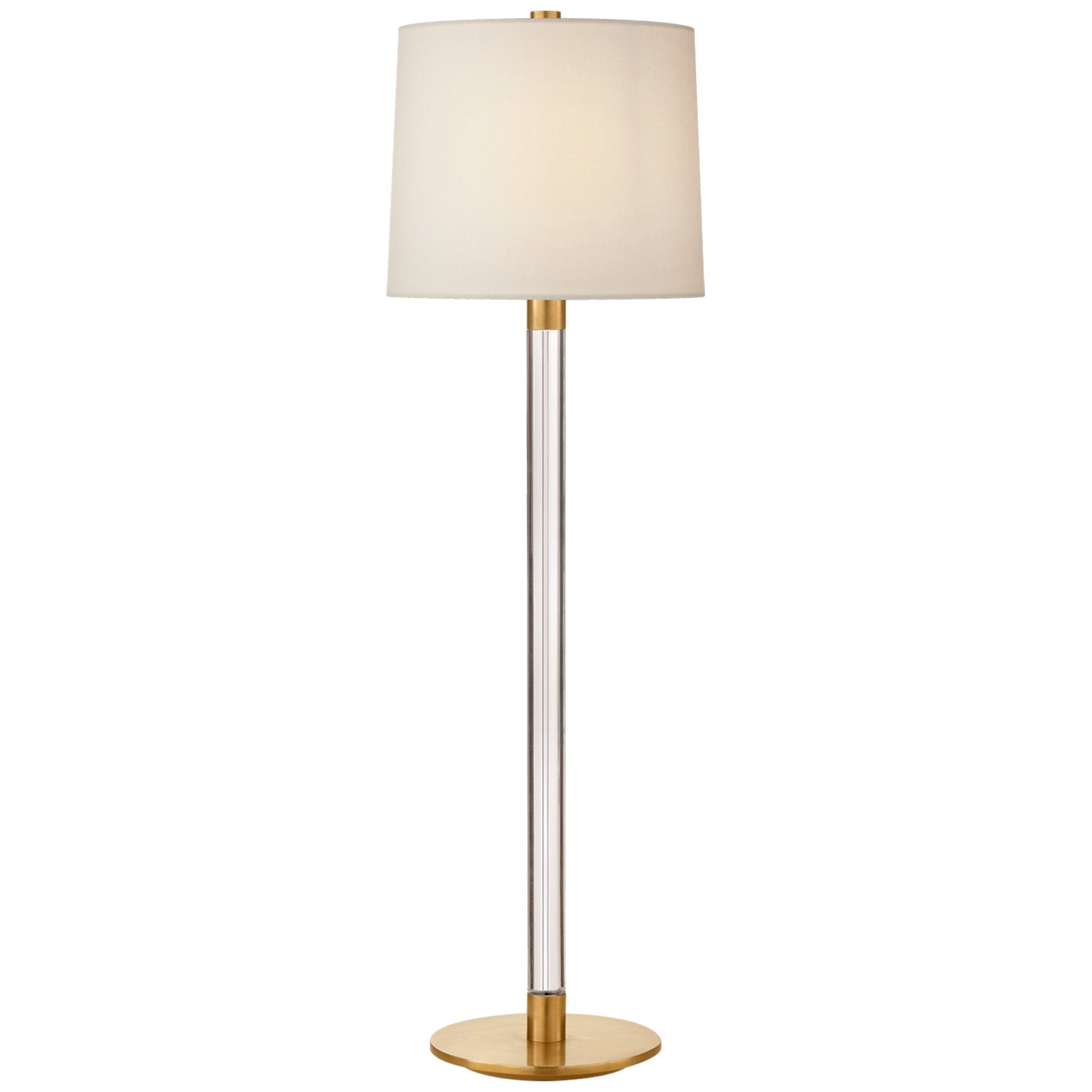
AERIN Riga Buffet Lamp in Crystal and Hand-Rubbed Antique Brass — W10" x H33". Tall and slender, it fits a narrow console without crowding keys and a catchall tray, and the crystal column adds a bit of sparkle to the welcome.
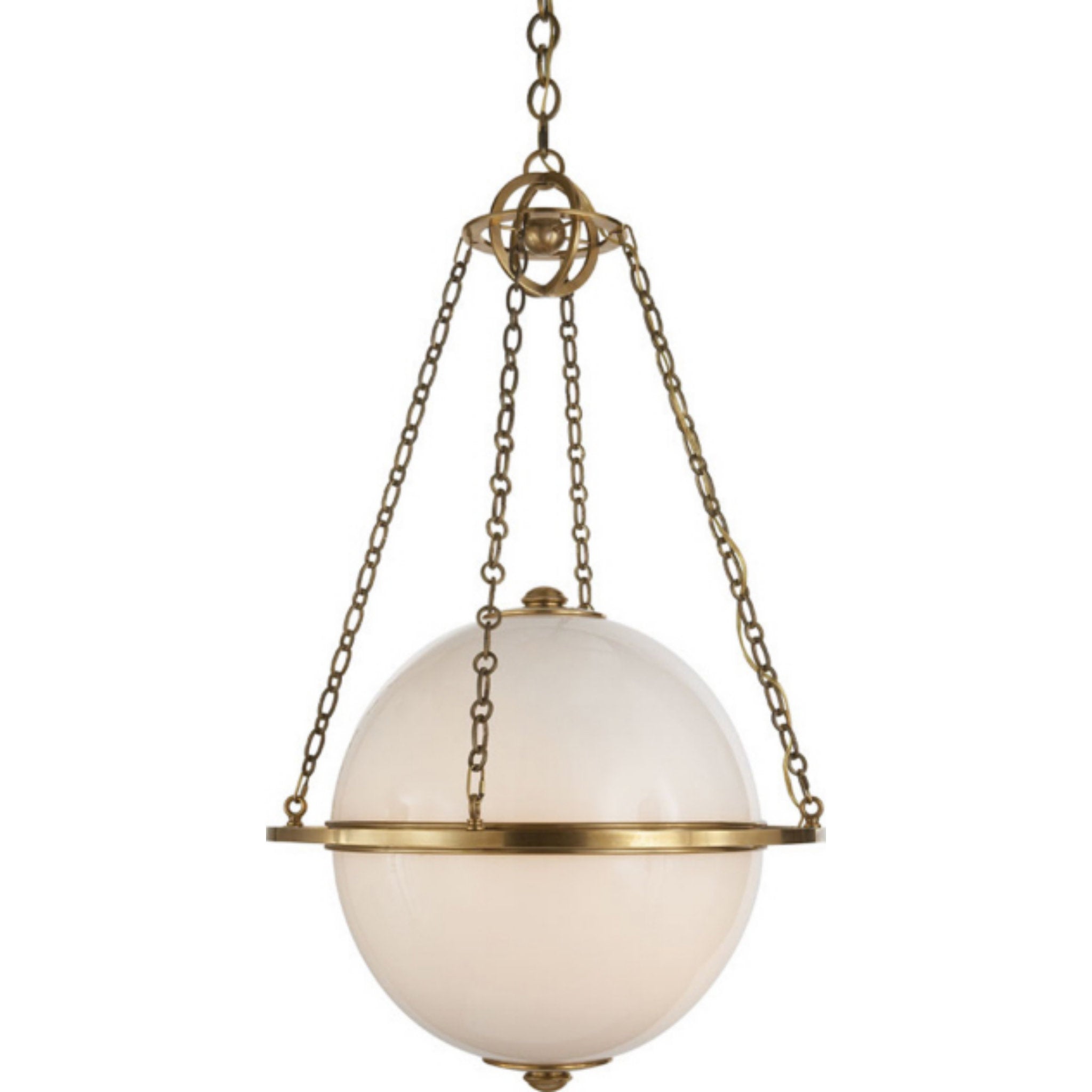
Chapman & Myers Modern Globe Lantern in Antique-Burnished Brass with White Glass — W24.25" x H39.25". For a modern entry around 12 by 12 feet with a tall ceiling, this elongated lantern offers height without excess width, and the white glass diffuses light softly in every direction.
Suzanne Kasler Morris Medium Lantern in Gilded Iron with Clear Glass — W19.75" x H26". A right-sized option for a 10-by-10-foot entry with a 10-foot ceiling, where it can hang with 7 feet of clearance and still feel substantial.
For sconces and console lamps to complete the entry, explore our wall lights and table lamps.
Measure once, then light the way in
Measure the foyer's length, width, and ceiling height, note the door swing and any window above it, and you have everything you need to choose a chandelier with confidence. If you are working on a larger project, Foundry Lighting's Design Trade Program supports designers and architects, and our New York and Los Angeles showrooms are a good place to see fixtures at full scale before you commit.
Shop this post

Frequently asked questions
How big should a chandelier be in a two-story foyer?
Add the foyer's length and width in feet and use that number in inches for the diameter, so a 20-by-20-foot entry takes roughly a 40-inch chandelier. For height, allow about 2.5 to 3 inches per foot of ceiling height, which means 45 to 60 inches for an 18- to 20-foot ceiling. Tall spaces usually benefit from sizing up.
How low should a foyer chandelier hang?
The bottom of the fixture should be at least 7 feet above the floor anywhere people walk. In a two-story foyer, most designers hang it so the bottom sits roughly level with the second floor, and center it in any window above the front door so it is visible from outside.
Can you put a chandelier in a foyer with an 8-foot ceiling?
A true hanging chandelier rarely works on an 8-foot ceiling because it drops below the 7-foot clearance line. Choose a flush-mount or semi-flush fixture instead, ideally one with a decorative profile so it still reads as a statement. Add sconces or a console lamp to fill out the light.
Should the foyer chandelier be centered on the front door?
Center the chandelier in the foyer's floor area first, then check the relationship to the door and any window above it. If the entry is symmetrical, the two usually align. If the door is off-center, centering the fixture in the room or on the stair typically looks more intentional than centering it on the door.
What color temperature is best for an entryway?
Warm white between 2700K and 3000K is best for most entryways. It feels welcoming, flatters wood floors and paint colors, and matches the warm glow of most exterior lanterns. Choose bulbs with a CRI of 90 or higher so finishes and art look true, and put the fixture on a dimmer.
Designing a whole room?
Our lighting specialists help size and pair fixtures every day, and interior designers and architects can join the Design Trade Program. Browse more ideas in Inspiration.