

Best Landscape Lighting for Modern Homes
The best landscape lighting for a modern home uses a few techniques with restraint: low path lights spaced 6–10 feet apart for safe walking, shielded uplights to sculpt trees and walls, downlights ("moonlighting") from high branches or eaves for a soft natural wash, and clean-lined wall and post fixtures to tie the architecture into the garden. Run it on low-voltage, keep it warm (2700K–3000K), and light less than you think.
Modern architecture looks its best at night when light reveals its planes, textures, and openings, and the garden recedes into calm shadow. The goal is not to make the yard bright. It is to choose a handful of things worth seeing and light them well. This guide walks through the core techniques, how to lay them out, and how to connect landscape lighting to the decorative fixtures on the house.
What are the main types of landscape lighting?
Almost every well-lit garden uses some combination of these five techniques. Most are done with small, brand-neutral low-voltage fixtures that are meant to disappear into the planting; the decorative pieces on the house and posts are what you actually see.
| Technique | What it does | Typical placement | Best for |
|---|---|---|---|
| Path lighting | Pools of light for safe walking | 6–10' apart, staggered | Walks, drives, garden paths |
| Uplighting | Sculpts form from below | 1–3 fixtures per tree; 12–24" from a wall for grazing | Specimen trees, textured walls, columns |
| Downlighting / moonlighting | Soft, natural wash from above | High in trees or under eaves, aimed down | Patios, lawns, seating areas |
| Wall washing / grazing | Reveals texture or smooth planes | Close to the wall for grazing; farther back for an even wash | Stone, board-formed concrete, stucco |
| Step and deck lights | Marks level changes | Every step or every other step | Stairs, terraces, decks |
How do you lay out landscape lighting?
Start from the views you care about, usually the approach from the street and the view out of the main living spaces, and work backward.
- Pick three to five focal points. A sculptural tree, a stone wall, a water feature, the front entry. These get the most light.
- Connect them with paths. Light the walks and steps people actually use, and stop there.
- Add the architecture. Wall lights at doors and garages and a post light at the walk or drive tie the house into the garden.
- Leave shadow on purpose. The dark areas between lit elements are what give the yard depth.
Shop the look
Tap the dots to shop this room

Shop the look

How far apart should landscape lights be?
Spacing depends on fixture output and beam spread, but these rules of thumb keep a layout even without overdoing it.
| Fixture | Spacing guideline | Tip |
|---|---|---|
| Path lights | 6–10' apart | Stagger sides; avoid runway rows |
| Tree uplights | 1 for small trees; 2–3 for large canopies | Place at the drip line or near the trunk depending on form |
| Wall grazers | Roughly as far apart as they are from the top of the wall | Closer to the wall = more texture |
| Post lanterns | At the walk entry, drive, gate, or turn | Decision points, not a fence line |
| Wall lights on the house | At doors and garage; 8–10' apart on long walls | Center ~66" above grade at doors |
What color temperature is best for landscape lighting?
2700K to 3000K suits most modern homes. It flatters wood, stone, and stucco and keeps the house feeling residential. Some designers use 3000K on foliage to keep greens crisp and 2700K on the architecture for warmth; the key is to stay consistent within each view. Choose high-CRI (90+) LEDs so plants and materials look natural, and avoid 4000K and above, which looks commercial on a house.
Is low-voltage landscape lighting better?
For in-ground and in-bed fixtures, low-voltage (typically 12V) is the standard for good reason. The cable is safer to run through planting beds, fixtures are easy to reposition as plants grow, and modern LED systems are energy efficient. A transformer with a photocell or astronomic timer turns everything on at dusk. Line-voltage wiring is still used for decorative wall lanterns, post lights, and fixtures on the house. Have a licensed electrician or landscape lighting contractor size the transformer, plan cable runs to avoid voltage drop, and handle any line-voltage work.
How should you light trees and walls on a modern home?
Modern landscapes tend to use fewer, more sculptural plants, which makes each one a candidate for light. A multi-stem tree such as a serviceberry or Japanese maple looks best uplit from two sides so the branching structure reads in three dimensions. A single upright tree can be lit from one fixture near the trunk. For broad canopies, move uplights out toward the drip line so the light fills the underside of the leaves.
Walls are where modern materials shine. Place a fixture close to a board-formed concrete, split-face stone, or textured plaster wall and aim it up to graze the surface; every ridge casts a small shadow and the texture comes alive. On smooth stucco or painted walls, pull fixtures back and wash the surface evenly instead, so you avoid scalloped hot spots. Where a wall meets a planting bed, a soft wash behind grasses creates a beautiful silhouette.
How do you avoid glare in landscape lighting?
- Hide the source. Use shielded or hooded fixtures and tuck uplights behind plants or stones.
- Aim away from sightlines. Never point uplights toward the street, the neighbors, windows, or seating.
- Use less output than you think. Low levels look more expensive than bright ones, and dark skies are a courtesy to neighbors and wildlife.
- Choose diffused decorative fixtures near doors and paths, especially on modern facades where bare bulbs can look harsh.
Get the look
Most landscape fixtures are small, low-voltage pieces meant to be unseen. What you do see are the decorative fixtures on the house and along the walk, and for a modern home those should be as considered as the architecture. For a board-formed concrete and cedar house with a gravel garden and multi-stem trees, we chose clean, dark forms that frame the landscape lighting rather than compete with it.
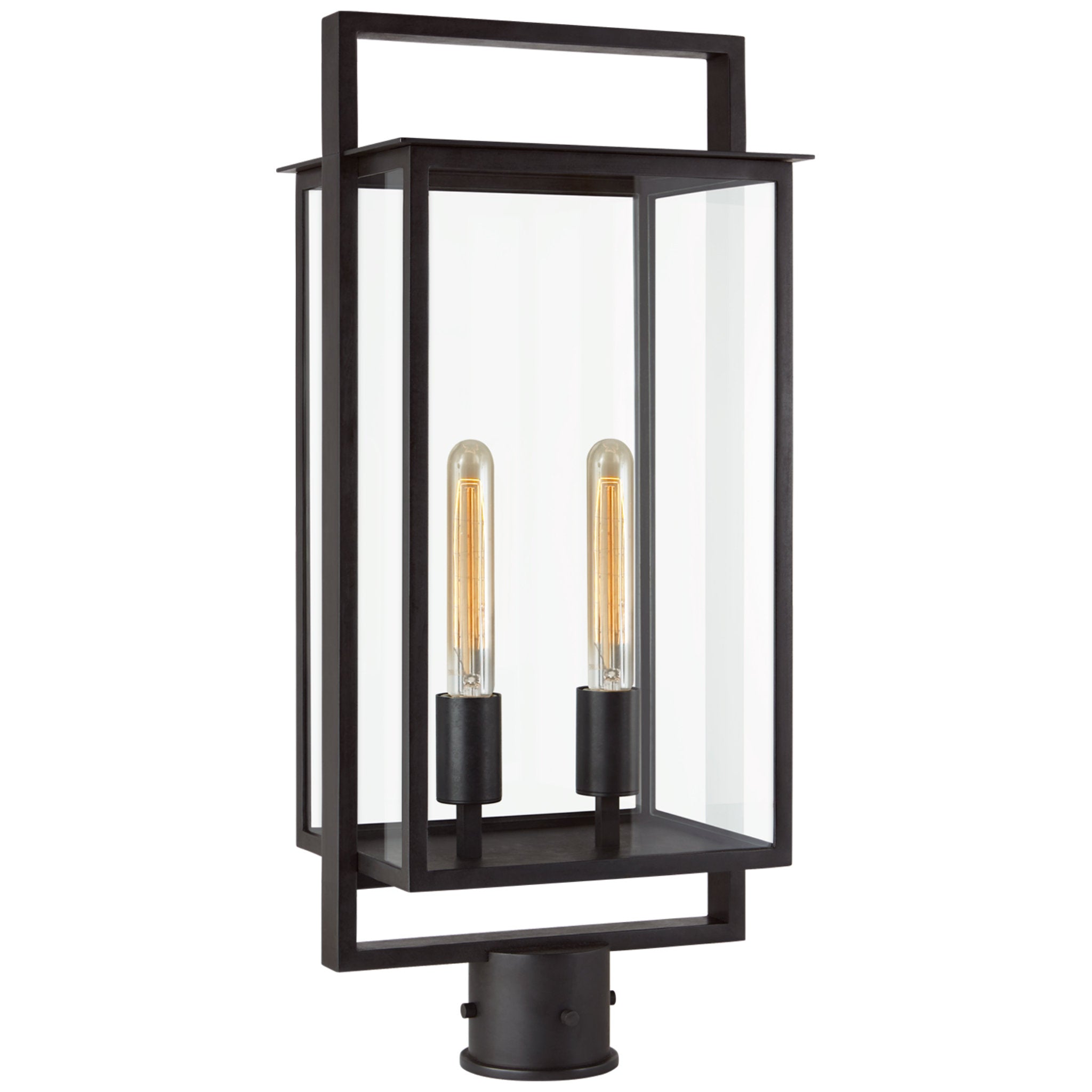
Ian K. Fowler Halle Medium Post Lantern in Aged Iron with Clear Glass — W11" x H26.75". Placed where the front walk meets the drive, this simple, modern post lantern marks the entry to the garden and gives the path lighting a clear starting point.
Barbara Barry Align 41" Shielded Wall Light in Blackened Stainless — W7.75" x H41" x E4.75". A tall pair flanks a pivot front door. The shielded design directs light along the wall rather than into eyes, which suits a modern facade and keeps glare down.
Kelly Wearstler Rega 24" Folded Sconce in Bronze — W5.25" x H24" x E3.25". Repeated along the cedar-clad garden wall, these sculptural folded sconces add a crafted detail at eye level and throw soft light onto the planting below.
Ian K. Fowler Halle Medium Narrow Wall Lantern in Aged Iron with Clear Glass — W6.25" x H19" x E5.5". A slim lantern for the side door and garden gate, where space is tight and you want the aged iron to echo the post lantern out front.
Start small, then layer
Light the entry and one great tree first, live with it for a few evenings, and add from there. For how the same approach works at the front of the house, see our guide to curb appeal outdoor lighting, and for poolside planning, our luxury pool lighting ideas. Explore more modern wall lights and post lanterns in the outdoor lighting collection and the Kelly Wearstler collection. Landscape architects and designers can work with Foundry Lighting's Design Trade Program on whole-property plans, and our New York and Los Angeles showrooms are open for comparing finishes in person.
Shop this post


Frequently asked questions
What is the best landscape lighting layout?
Choose three to five focal points, such as a specimen tree, a textured wall, and the front entry, and light those first. Connect them with path lights spaced 6 to 10 feet apart, add wall lights and a post light for the architecture, and leave shadow between lit areas. Restraint is what makes landscape lighting look designed.
How many landscape lights do I need?
There is no fixed number; it depends on how many focal points and paths you have. As a rough plan, allow one to three uplights per feature tree, path lights every 6 to 10 feet along used walks, a fixture at each step or level change, and wall lights at every exterior door. Start with fewer and add once you see them at night.
What is moonlighting in landscape lighting?
Moonlighting means mounting downlights high in a mature tree and aiming them down through the branches. The light filters through leaves and casts soft, dappled shadows on the lawn or patio below, imitating moonlight. It is one of the most natural-looking techniques and works well over seating areas and paths.
Is 3000K or 2700K better for landscape lighting?
Both work. 2700K is warmer and flatters wood, stucco, and traditional materials, while 3000K keeps foliage slightly crisper and suits modern concrete and stone. Many designers use 2700K on the house and 3000K in planting. What matters most is staying consistent within a view and using high-CRI LEDs.
Can I install low-voltage landscape lighting myself?
Many homeowners install plug-in low-voltage kits, but a professional layout usually looks better and lasts longer. A contractor sizes the transformer, plans cable runs to prevent voltage drop, and aims fixtures to avoid glare. Any line-voltage work, including new outdoor outlets and wall or post lanterns, should be done by a licensed electrician.
Designing a whole room?
Our lighting specialists help size and pair fixtures every day, and interior designers and architects can join the Design Trade Program. Browse more ideas in Inspiration.